Showing posts with label minimalism. Show all posts

Wednesday, March 13, 2013

It's Future Wednesday, And It Sucks.

In case you haven't noticed, we're living in the future.  For instance, consider that smartphone you're always rubbing.  That's how you know we're living in the future, because that's future shit.

Sometimes I love living in the future.  For example, in the future we have the Internet, which is incredible.  Every day we upload the sum total of all human knowledge onto this thing, where it becomes readily accessible to everybody in the world except the Chinese, the North Koreans, and women in Islamic countries.  Sure, as it turns out, the sum of all human knowledge mostly consists of "fail" videos, but it's still pretty amazing

On the other hand, the future kind of sucks, too.  We may have the Internet, but arguably that's the only real improvement, and there's a strong case to be made that we're simply living in a lamer version of the 1980s that has Wi-Fi.  Also, there was a time when the counterculture was actually interesting. Punk rock.  Black power.  LSD freakouts.  Ken Kesey and his "Merry Pranksters."  Now, we just have these assholes called "minimalists," and here's another one to which I was alerted by many readers:


I LIVE in a 420-square-foot studio. I sleep in a bed that folds down from the wall. I have six dress shirts. I have 10 shallow bowls that I use for salads and main dishes. When people come over for dinner, I pull out my extendable dining room table. I don’t have a single CD or DVD and I have 10 percent of the books I once did.

Good for you.  You're not special.  You're a typical single Manhattanite.  Nobody has CDs anymore, you might as well boast about not owning a bellows or a chamberpot.  Six dress shirts is actually a lot.  Also, it's called a "Murphy bed."  It's nothing special either.  Charlie Chaplin was doing schtick with one a hundred years ago.  Fascinating about your extendable dining room table.  When people come over to Mario Cipollini's apartment for dinner, he pulls out his extendable penis:


("Jeeves, fetch the leaf for Little Mario, we have company tonight.")

Nevertheless, even though he's not remotely special, he thinks he's special, because he made lots of money when he was young and went on the world's lamest spending spree:

To celebrate, I bought a four-story, 3,600-square-foot, turn-of-the-century house in Seattle’s happening Capitol Hill neighborhood and, in a frenzy of consumption, bought a brand-new sectional couch (my first ever), a pair of $300 sunglasses, a ton of gadgets, like an Audible.com MobilePlayer (one of the first portable digital music players) and an audiophile-worthy five-disc CD player. And, of course, a black turbocharged Volvo. With a remote starter!

The first red flag here is that he uses the words "Seattle" and "happening" in the same sentence.  Moving to the "happening" neighborhood in Seattle is like ordering the "artisan" bread at Subway.  Then he uses $300 sunglasses as a symbol of consumer excess.  Please.  That's entry-level when it comes to Fred optics.  And a Volvo, really?  When you're a young douchebag who suddenly falls into a pile of money you're supposed to buy a Porsche or a Ferrari, numbnuts.  Basically, it sounds like after striking it rich he decided to live the life of a 45 year-old schoolteacher.

But then he really went wild:

I was working hard for Sitewerks’ new parent company, Bowne, and didn’t have the time to finish getting everything I needed for my house. So I hired a guy named Seven, who said he had been Courtney Love’s assistant, to be my personal shopper. 

Seven?  Like in "Seinfeld?"  I realize that after Kurt Cobain killed himself Courtney Love was the only celebrity left in Seattle, but even so hiring her assistant makes as much sense as hiring Michael Jackson's physician.

Needless to say, Seven turned this guy's upper middle class conservative lifestyle into a nightmare:

My life was unnecessarily complicated. There were lawns to mow, gutters to clear, floors to vacuum, roommates to manage (it seemed nuts to have such a big, empty house), a car to insure, wash, refuel, repair and register and tech to set up and keep working.

Maybe if you'd fired Seven and hired a gardener and a housekeeper then you wouldn't have had these problems.  And what's with the roommates?  Haven't you ever heard of a dog or a cat?  Getting a pet is Sad Single Person 101 for chrissakes.  Walking a dog or cleaning out a litter box in between lonely wanking sessions in your giant house would have given your life meaning.


It got worse. Soon after we sold our company, I moved east to work in Bowne’s office in New York, where I rented a 1,900-square-foot SoHo loft that befit my station as a tech entrepreneur. The new pad needed furniture, housewares, electronics, etc. — which took more time and energy to manage.

AND because the place was so big, I felt obliged to get roommates — who required more time, more energy, to manage.

More roommates?!?

Then he meets Olga:

I DON’T know that the gadgets I was collecting in my loft were part of an aberrant or antisocial behavior plan during the first months I lived in SoHo. But I was just going along, starting some start-ups that never quite started up when I met Olga, an Andorran beauty, and fell hard. My relationship with stuff quickly came apart.


I followed her to Barcelona when her visa expired and we lived in a tiny flat, totally content and in love before we realized that nothing was holding us in Spain. We packed a few clothes, some toiletries and a couple of laptops and hit the road. We lived in Bangkok, Buenos Aires and Toronto with many stops in between.

Surprise!  All the dorky guy with the Volvo and the roommates needed was to get laid.  Who'd have thunk it?


I’m still a serial entrepreneur, and my latest venture is to design thoughtfully constructed small homes that support our lives, not the other way around. Like the 420-square-foot space I live in, the houses I design contain less stuff and make it easier for owners to live within their means and to limit their environmental footprint. My apartment sleeps four people comfortably; I frequently have dinner parties for 12. My space is well-built, affordable and as functional as living spaces twice the size. As the guy who started TreeHugger.com, I sleep better knowing I’m not using more resources than I need. I have less — and enjoy more.

My space is small. My life is big.

Let me tell you something.  Your "thoughtfully constructed" 420-square-foot space is not functional or comfortable for more than one person, nor is it "as functional as living spaces twice the size."  Sure, maybe your 12 miserable dinner guests lie to you and say that they're comfortable--or, more likely, they're the types of uptight people who don't mind sitting ramrod-straight around an extendable dining table while clenching their sphincters.  However, normal people who like to eat a big meal and then relax on the couch are fucking miserable.  Just because you bought a bunch of lame shit when you were younger and now like to putter around in a tiny box folding and unfolding modular furniture doesn't mean you're saving the world from itself, in the same way that being in AA doesn't mean the rest of us can't keep drinking.  I eat sandwiches bigger than your apartment, and that's the way I like it.


And that's not all that sucks about the future.  Not only do we have to listen to rich minimalists who are wracked with buyer's remorse, but soon we're also going to be wearing disposable hats--at least according to this promotional email I received:


Hi There, 

I hope all is well! A quick Veloce update: We have just launched our Superveloce Collection. The Superveloce Collection is the world's first disposable hat collection. We believe that single-use clothing is the wave of the future in terms of party attire. After conducting market research we discovered that our primary demographic purchases our hats for a specific reason-either a party, concert, or greek event. With this in mind, we concluded that the price point of our hat for these loyal customers may be a bit high. As such we created a single use line that is visually identical to our Partyme Collection, our most popular collection. We have launched with our two most popular colors, Electric Blue & Lime Green. Each hat is offered at the incredibly low price of $4.99. That is at least a 75% price reduction if compared to our regular lines.  The new hats feature a more flexible brim, and even lighter weight crinkle taslan material. I've attached our line sheet with more information. 

Hmmm, in the old days we used to call those "painter's caps."  Oh, here's what the hats look like:


I haven't seen a model that humiliated since Wikipedia nonplussed bib shorts guy:


Wait, holy crap!  Disposable bib shorts!  I'd better get a Kickstarter going!

Perhaps the worst thing about the future though is how stupid road bikes have become, though a reader tells me you can now own this Specialized Venge Schmenge for "only" $6,100:


(Saddle pre-tilted for your convenience.)

Venge Pro full carbon race road bike - $6100 (vallejo / benicia)


PRICE REUCTION TO MOVE THIS BRAND NEW BIKE NOW!
This is THE 2012 Venge Pro full 10R race carbon road bike with 126 miles on it. She is a size 56cm, one month old and flawless!! She has full ultegra components with.... get this... the Ui2 electronic shifting. That alone with all the components wire harnesses programmer, battery, charger, etc is $1700 not installed. One of the coolest things about this shifting is not only can you shift under full load with no chain slap, but when shifting the rears it automatically trims the front derailers thus never rubbing. This is THE premier bike to own. Not only does it dominate in the time trials, but is crazy light at 16.5lbs. She has full one piece carbon aero bars with a removable carbon computer "T" extension tree, even the bar ends are carbon. The cranks are Fact Carbon, the forks.. Fact carbon, wheels are race carbon and balanced. This bike is so sweet and fast. Super stiff and all new ceramic bearings from the BB to the hubs and even the guide sprockets all have ceramic bearings. I am including a brand new set of Garmin race jersey and padded shorts along with the pictured Specialized set. I am even including a the set of Time iClick pedals and specialized carbon race shoes and cleats size 44.5.
The Venge pro is no longer being offered with all the goodines that this one has on it. She was a special order bike that I hate to see go, but I'm taking my skydiving to a whole new level and buying a BASE rig and upgrading my wingsuit and need the money which is why I am including ALL the other things, even extra tubes, the bottle and cage, shoes, shorts, jerseys, Giro carbon helmet, i click pedals and cleats even an extra stem and the original bars. Thanks for looking (707) three three4-35 six nine. I also have a Carbon Tarmac for sale here if you are just looking for a carbon roadbike that performs well and has new parts on it.


Yes, that's right, his loss is your gain, because he's committing all his disposable income towards becoming the biggest Sky Fred he can be.  By the way, I had to look up "wingsuit," and here's what I found:


That's awesome.  He looks like some kind of intergalactic space bishop.

Indeed, he's so desperate that he's including his disgusting used clothes:


And he's even using the latest in persuasive sales tactics, such as this cockpit shot complete with disembodied feet:


I'm pretty sure he's sporting the foot tattoo/anklet combo too:


As I understand it, you get a foot tattoo and an anklet free with your subscription to "Outside" magazine.

Anyway, I'm willing to bet this guy declares himself a minimalist in six months.

Lastly, as everybody knows, the trendy bicycle of the future is the so-called "fat bike," though if you prefer something a bit more "classic" for your snowy adventures then you could do worse than this contraption which was forwarded to me by another reader:


RALEIGH FRAMED PROFFESIONALY  CONVERTED SNOW BIKE !!!

NOVALTY ITEM  THAT I HAVE NO USE FOR THAT WAS FOUND IN A HOUSE CLEARANCE

IN VERY GOOD CONDITION

JUST ADD SNOW !!!

ITEM IS LOCATED IN THE THIRSK/YORK AREA

COLECTION IN PERSON ONLY

99P START  COME GRAB A BARGAIN

UK BIDDERS ONLY PLEASE

THANKS


Stem's a little long though.

Wednesday, December 21, 2011

2011: The Year the Walls Kept Closing In

As 2011 draws to a close, it will be remembered for many things: the #Occupy movement, the death of ruthless North Apple CEO and dictator Kim Jobs-Il, and the UN resolution to enforce sanctions against Portland, OR for crimes against humility all leap to mind. However, there is one phenomenon that has come to define the year 2011 above all else. That phenomenon is minimalism.

Minimalism is a movement consisting of people who admire modern furniture and who covet Apple products, and who have deftly hidden their avarice beneath a veneer of spirituality as deftly as Kim Jobs-Il hid the workings of his products beneath pieces of brushed aluminum. Well, yesterday I mentioned The World's Douchiest Wedding, and as it happens the groom's boss and "keynote speaker" at the wedding (when you don't have friends, you get a "keynote speaker" instead of a best man) is quite an accomplished minimalist named Graham Hill. In fact, Hill even gave one of those "TEDTalks." TEDTalks basically consist of people from various fields verbally "foffing off" before a disgustingly appreciative audience, and Hill pleasured himself so sensuously during his that the "Huffington Post" included it in their "Best of TED 2011 Countdown:"

Here is the video itself, but if you're squeamish about watching men masturbate I've also included a summary below:


Hill begins his presentation while seated on a box. This box is what motivational speakers call a "prop," or a "hackneyed symbol," and presumably Hill came up with this one after watching George Clooney do his whole backpack schtick in the movie "Up in the Air:"


Hill then explains that we have lots more space now:

"Did you know that we Americans have about three times the amount of space we had 50 years ago?"

Which, for some reason, is a problem. Then, he starts in on the whole minimalist "joys of less" thing:

"I bet most of us have experienced at some point the joys of less. College, in your dorm; traveling, in a hotel room; camping, where you've got basically nothing, maybe a boat... Whatever it was for you, I bet that among other things, this gave you a little more freedom, a little more time."

Well, yeah, traveling or camping might give you "a little more freedom, a little more time," but that's because when you do those things you're on vacation. People take all kinds of vacations, but that doesn't mean we should use our vacations as a template for life. Some people's idea of a great vacation is going to Disneyworld. Does that mean we should all wear Mickey Mouse ears and adopt the Disney Dollar? That's what most of Europe did with the Euro, and it doesn't seem to be working out too well for them. As for the joys and freedoms of college, that's less about the minimalist functionality of dorm room living and more about stuff like drunken parties, four-foot bongs, and not being an adult yet. Nevertheless, the conclusion Hill draws from all of this is as follows:


Fine. Sure, life can be a bit easier if you trim the proverbial fat now and again, but this is hardly a revelation to anybody except a minimalist like Graham Hill, for whom even the basic mechanics of life are all transcendent. So did he take his incredible discovery that everybody else knew already, use it to make his life better, and proceed shut the hell up about it? No, he didn't. Instead, he started a project called "Life Edited" to "further this conversation and to find some great solutions in this area:"

So how do you "further conversations" and "find some great solutions" to the painfully obvious? By "crowdsourcing" the interior design of your crappy apartment:


"I wanted it all," explains Hill. "Home office, sit-down dinner for 10, room for guests, and all my kite-surfing gear." Ah, yes, kite-surfing, the Rollerblading of the sea.

So basically, he wanted a douchebag's dream apartment in which he could stow his goofy sporting goods and entertain his friends who also wear sport jackets with jeans and who doubtless Rollerblade on land, sea, and air. So, being the good minimalist that he is, he immediately paid way too much for almost nothing--or, as he explains it, "By buying a space that was 420 square feet instead of 600, immediately I'm saving 200 grand:"


Wow. If he saved $200,000, that works out to $1,111.11 per square foot, which in turn means the guy telling us how to make our lives better by saving money paid $466,666.66 for his tiny shitbox.

Not only that, but he also says that "because it's really designed around an 'edited' set of possessions--my favorite stuff--and really designed for me, I'm really exited to be there." Note the crazed eyes as he tries to convince himself that he actually enjoys living in a half-million dollar version of the trash compactor from "Star Wars:"

I will give Hill one thing, which is that he's a refreshing antidote to all those HGTV shows about flipping houses and getting rich with real estate. Instead, here's a guy telling you to simply spend a fortune to confine yourself in a tiny space specifically so you can go broke--or, as he calls it, "live little."

"So how can you 'live little?," asks Hill rhetorically, since anybody with any sense now sees his life as a cautionary tale. "Three main approaches." Here's the first:


What does that mean? Well, it means "That shirt, that I haven't worn in years? Time for me to let it go."

Wow, that's some ruthless editing. But getting rid of that shirt isn't enough, because "Secondly, our new mantra, 'Small is Sexy:'"

Hill may have inadvertently revealed something about his own physical attributes here. I guess minimalism is the new "overcompensating." In other words, Porches are out, tiny apartments are in. Also, "Why have a six-burner stove when you rarely use three?"

Really, this is the problem, people with too many burners? Who the hell even has a six-burner stove anyway? Is that thing Photoshopped?

But the third and final part of his brilliant scheme of self-imprisonment is by far the most cunning, and that involves having stuff that's "multifunctional:"


Or, to put it in layman's terms, having a sink that's also a toilet:

So basically, here's a man who lives in a half-million dollar home the size of a minivan and is forced to brush his teeth and defecate in the same bathroom fixture telling us how to live. This guy truly is the world's worst motivational speaker. "One day," he might as well be saying, "if you work really, really hard, you too can wash your hands in your own pee."

Also, he sleeps on his dining table:

You've probably heard the expression "Don't shit where you eat." Presumably though it's okay to sleep where you eat, and then the next morning to brush your teeth using the same fixture into which you defecate.

Most crucially though, everything folds:

Which I'm sure is a lot easier and more efficient than simply walking into another room in a larger half-million dollar home that's actually worth what you paid:


All this to have a "smaller footprint," making this lifestyle the 21st century equivalent of footbinding.

Amazingly though, after all this, Hill still has the audacity to tell us to "Consider the benefits of an edited life."

Right, let's see, as far as I can tell the benefits are:

--Spending a ton of money
--Having very little to show for it
--Having to fold your entire apartment like a paper fortune teller every time you need to take a dump

In recent years, people like this have been ruining the word "curate" by using it when they mean "edit." Now, though, they want to ruin the word "edit" too, since sometimes editing means actually adding stuff. I think the word Hill is looking for here is "mangling."

Anyway, the video is accompanied by words from the groom from The World's Douchiest Wedding, who adds this:

We launched the LifeEdited project last year because we believe the story of humankind needs a good edit.

Humankind needs a good edit, huh? They're in good company. Kim Jong-Il thought the same thing.

Oh, also, this apartment will be "the launch pad for an editing movement:"

This small apartment will be the launch pad for an editing movement. We envision a future with large-scale developments that have beautiful, compact units, communal spaces and sharing systems. These spaces are extremely energy efficient and have healthy, safe air. These developments will support people in focusing on what's important to them. We envision a world where people spend more time with one another, where possessions and time can be shared, not hoarded, where products are passed onto children, not trash collectors

Yeah, right. You couldn't launch a water rocket out of that overpriced Rubik's Cube.

The only explanation I can possibly come up with for minimalism as a philosophy is that the 1% is using their lackeys in the 10% to convince the remaining 90% that cleansing and relieving yourself in the same body of water is actually desirable, and by 2050 we'll be back to fiefdoms.

Speaking of desirable, I don't really get the whole embrocation obsession in cycling, but apparently the only thing more desirable than burning hot goo is burning hot goo that's the subject of an intellectual property dispute:


Hot and hard-to-find (we ordered ours from New Zealand), Qoleum is the subject of an intellectual-property dispute that at least one expert tester felt "added to the mystique." Testers also praised it for its scent and for being easy to apply.

Bratz dolls were also the subject of an intellectual property dispute. Why not just rub one of those on your leg?

Tuesday, July 26, 2011

Small World: The Way We Were

Who among us has not occasionally longed to travel back in time?

For example, what if you could ride a dinosaur? Or witness the signing of the Declaration of Independence? Or ride a dinosaur through the signing of the Declaration of Independence and upload video of your stunt to YouTube, which you now own, because you have a time machine, and you can do anything you want and the world is now a twisted product of your perverse whims, and the ensuing paradoxes are tearing the very fabric of the universe asunder? Or maybe this has already happened and what we perceive as "reality" is merely the construct of someone who has had or will have or will have had had a time machine and used it to meddle with history, and because of this we have no control whatsoever over our own destiny and merely dwell in a self-perpetuating perdition of temporal contradictions?

Fine, so maybe time travel isn't all that great. Still, at least you can safely experience what it would be like to travel way back to the year Two Thousand And Aught Seven, Anno Domini, thanks to a Canadian periodical called "The Glo Bean D Mail," which contains the following article forwarded to me by a reader:

Ah yes, 2007. People "boogied" to the sounds of Incubus and The Red Hot Chili Peppers. Audiences thrilled to movies like "Wild Hogs" and "Norbit." And newspapers printed articles about "fixies" which contained passages like this:

Popularized by bike couriers as a fast, simple way to charge around town, the fixie has become the ride of choice for young downtown cyclists – a personal statement and urban art form in one.

Amazingly though, the above words were not published in 2007. They were actually published yesterday(!), in the aforelinked "Glo Bean D Mail" article. So, too, were these:

Some come with stubby, shortened handlebars to make it easier to squeeze between cars. Some have swooping ram’s-horn bars of gleaming chrome, stripped of all handlebar tape. Others have wheel rims made of bright anodized aluminum in pink or gold. Still others have snappy whitewall tires. The latest thing is to have a coloured bicycle chain to match the bike’s colour scheme. A leather seat by Brooks, the storied English saddle maker, often tops things off.

After reading this, I have three questions for the writer, none of which has anything to do with "fixies:"

1) What's it like to be cryogenically frozen for four years and did it hurt when they thawed you out? (Okay, that's technically two questions, but whatever.)

2) Are you bummed you didn't get to see "Avatar" in the theater?

3) Michael Jackson died. How crazy is that?!?

Of course, those of us who have actually had to live through the past four years know how it all went down: first came the fixie fad; then the fixie scene closed; then all the fixie scenesters discovered bikes with gears and reinvented themselves as insufferable pedants. It was, in a word, horrible. But I guess it all seems perfectly delightful when you missed the whole thing because you're the Rip Van Winkle of the "bike culture:"

Still, the rise of the fixie is a healthy sign of a maturing bike culture in the city. Like high-school kids, urban cyclists are dividing into tribes. The nerds are the guys with panniers and reflecting vests; the jocks are the road-bike riders in spandex; the artsies ride vintage women’s bikes with flowers in the basket; the fixie riders, of course, are the cool kids.

Wrong. Wrong! They're all nerds. Have you really not figured that out yet? Or do you still have freezerburn on your brain?

Meanwhile, everybody knows that fixies are totally "out," and interesting hats are totally "in:"


On the train from Oyster Bay - w4m - 29 (City-bound on LIRR)
Date: 2011-07-24, 11:49PM EDT
Reply to:

You boarded the LIRR at Oyster Bay on Sunday evening with your bicycle, an interesting hat, and a copy of the Economist. I was the girl with a gray tank top and dirty blonde wavy hair, jabbering with my Irish friend, but too tongue-tied to talk to you. Did your bike survive the fall?


I've ridden the Long Island Railroad countless times and I've never seen anybody even remotely that pretentious. It must be a North Shore thing. A bicycle? Sure. An interesting hat? Possibly. A copy of the Economist? Perhaps. But all three at once? That's almost as impressive as a guy with a Swedish military bike and a weary Portuguese friend! But the big question is:

So how interesting was the hat?

I mean, was it really interesting, or just mildly interesting? For example, there was a time back in 2009 when I thought the "tricorne" was going to make a comeback, since I saw someone wearing one on the street:

So was the hat that interesting, or was it just "beer hat" interesting? Actually, maybe that's the guy she saw on the train. If so, I'm glad to have helped.

Speaking of pretension, I was reading the July 25th issue of The New Yorker recently and there was an article about "tiny houses:"


Evidently, there is a growing subculture of people who are into tiny houses, and it appears to be the next evolutionary phase of minimalism:

The occupants of tiny houses tend to be committed, and slightly self-regarding, citizens, who cook on little stoves and have refrigerators like wall safes. They shed years of possessions and keepsakes to get by with two shirts and two pairs of pants and two mugs and two forks, in order to occupy what amounts to a monk's cell, for the sake of simplicity, frugality, or upright environmental living. They often embody the zeal of religious converts.

And because shacks are too "Hatfields and McCoys" for minimalists, and cottages are too "Grimm's Fairy Tales," they've invented a new form of pretentious dwelling that splits the difference:

They aren't toys or playhouses or aesthetic gestures--a copy of Monticello as a sandbox in a field in East Hampton, say--and they aren't shacks or cottages, either. Shacks don't have kitchens and bathrooms, and a cottage is larger than a tiny house.

In other words, a tiny house is basically an artisanal mobile home, and people pay up to $54,000 for them:

The tiniest house that Tumbleweed Tiny House Company sells is the XS-House, which is sixty-five square feet, and costs sixteen thousand dollars to build yourself, or thirty-nine thousand dollars if Tumbleweed or someone else builds it for you. Tumbleweed's most expensive house, the Fencl, is a hundred and thirty square feet; it costs twenty-three thousand dollars to build yourself and fifty-four thousand dollars to have built.

Of course, the tiny house movement is a reaction to the McMansions and jumbo mortgages and bursting bubbles and crushing financial burdens that characterize life in modern-day America:

According to Greg johnson, the publisher of a tiny-house Web site called ResourcesForLife.com, to inhabit a tiny house "you have to remodel your sense of what success is and how important it is to you to convey to the outside world 'Hey, I have a big house and big car and I'm successful.' If you have a piece of inner tranquillity, you don't have to prove anything to anybody."

I can certainly understand that people want to liberate themselves from excess and live more modestly, manageably, and efficiently. To that end, I've come up with a revolutionary idea. Imagine if, instead of living in garden sheds, people lived in sort of "tiny house collectives"--large structures containing multiple tiny houses within their walls. Not only would such structures be more efficient than single-family dwellings, but they would also foster a sense of community and even allow for cooperative ownership arrangements. We could call these tiny houses "apartments," and we could call the tiny house collectives "apartment buildings."

Now, imagine multiple "apartment buildings" in close proximity to each other, and the dynamic communities that would result--hundreds, thousands, or even millions of people living in tiny houses and sharing ideas and experiences and creating economies and forming governments. I haven't come up with a catchy name for these communities yet, but I'm thinking either "cities," or else "people nuggets." Then, if for some reason you decide you actually need or want more living space than the people nugget contains, you can just leave it and move into a normal fucking house.

Unfortunately though, tiny house minimalists can't seem wrap their minds around the concept of living in a place that suits their needs. Instead, it makes much more sense to them to live in a miniature version of the McMansion that offends them so much, possibly with one of these on their microscopic front porch:

(America 2.0: Tiny Houses and Tiny SUVs)

In other words, the minimalist/tiny house ideal seems to be to return to the way life was back in the Middle Ages by transforming America into a land of fiefdoms dotted with designer hovels in which the inhabitants have no equity.

Of course, whatever sort of dwelling you inhabit, you should make sure you lay your head on a cycling-specific pillow, as forwarded to me by a reader:

I predict pillows for cyclists will reach prices of up to $5,000 in the next few years, after which urban cyclists will reject pillows and begin sleeping without any sort of head support at all and we'll start seeing articles about a new "fixed-head sleeping movement," and about how some of these crazy urban sleepers are even running their beds blanketless.

Just make sure you don't sleep without your helmet.

Tuesday, May 31, 2011

10 Items or Less: The Avocado of Death

In today's modern world of today, there are innumerable evils facing our modern society. Nukelear meltdowns, international financiers who grope hotel staff, and a dependence on foreign desserts are just a few of these insidious threats to our very existence. However, when it comes to negative influences, there is one that looms larger than all others:

Minimalism.

Sure, you might think that a movement consisting bunch of rich, iPad-wielding couch surfers with a penchant for borrowing stuff would be relatively benign. Think again--unless you're a minimalist, of course. Minimalists only think once, if at all. They like to keep their heads as empty as their apartments.

The truth is, minimalism is a philosophy of denial, and in this sense it's the Creationism of lifestyles. Creationists deny the mountains of tangible evolutionary evidence we walk on, dig in, and burn in our gas tanks every day in favor of a story they prefer to believe. Similarly, minimalists deny the principles of simple mathematics in favor of a subjective form of accounting that would amaze even a Goldman Sachs executive.


He arrived at his number by arbitrarily omitting stuff (like his toiletry kit), as well as by bundling other stuff together (like his electronics and various chargers) and counting them as one thing. It's that last form of fictional counting--bundling stuff together--that's the most insidious. For example, bundling a bunch of subprime mortgages together and selling them was what caused the financial crisis. Even worse, bundling items together is wreaking havoc at our supermarket checkout counters, as I learned this past weekend:

The above was the scene I encountered in a Brooklyn supermarket at the so-called "10 items or less" register. As you can see, there are ten items of fruit on the conveyor belt alone--and that's not counting what the cashier has already bagged!

At first I puzzled over how someone could commit a civil violation so egregious, but then I realized that this twisted minimalist counting style is now trickling down to the rest of society, and that the woman purchasing all this stuff has probably deluded herself into thinking that all those avocados are one item. (In fairness to her, the juice wasn't hers--it belonged to the gentleman with the giant fanny pack waiting behind her.)

A mortgage crisis is one thing, but glutted supermarket checkout lines are something else altogether, and the consequences of the latter are potentially far worse. Not only does it cause delay, but allowing people to purchase multiple avocados via express lane while simultaneously inconveniencing purchasers of other items could lead to an "avocado bubble" that could burst with tragic consequences--and I don't want to be around when the guacamole hits the fan.

In any case, I've never shied away from social protest, and you can be sure I did my part by sighing impatiently in a barely audible fashion.

Speaking of counting stuff, Transportation Nation is attempting to quantify the New York City bicycle crackdown, and to this end they're creating a bike ticket map to show which neighborhoods in have been most cracked down-upon. Here's how the map looks so far:

(Each red mark represents an extremely indignant white person.)

As you can see, ticketing seems to be heaviest in parts of the city inhabited by the sorts of whiny people whose biggest problem in life is having to wait behind other people buying too many avocados in supermarkets. Non-coincidentally, these are also exactly the sorts of people who send out press releases to local news websites when they get tickets for running red lights on their Dutch bikes, and who ultimately report this information to crowdsourcing projects run by smug transportation websites. The result of this project is what may be the most obvious map ever created, though I am admittedly intrigued by the outliers, such as this one:

I can only assume this represents a roadie on his way to or from the evening races at Floyd Bennett Field (the big beige blob in the middle of the image), and I must say that surviving the wild ride down Flatbush Avenue only to get a ticket just as you've reached the safety of the Gateway National Recreation Area is like winning the World Rib Eating Championship and then choking to death on a maraschino cherry as you enjoy a celebratory cocktail.

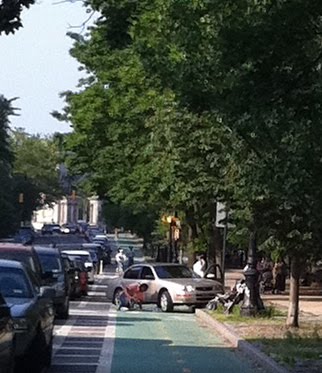
Meanwhile, drivers are constantly finding bold new ways to obstruct bike lanes. For awhile, it looked like the protected ones were posing a bit of a challenge, but I'm pleased to report that one motor vehicle owner has finally cracked the problem of how to block them by simply placing his car diagonally across the controversial Prospect Park West bike lane:

I'm not sure what they were actually doing, but they are taking rope out of the trunk so it's possible that they were tying the car back together. The blanket would also indicate they needed to do some work on the underside of the vehicle:

Perhaps by parking the car partially on the curb they afforded themselves easier access:

As for why they wouldn't simply work on the car in the empty parking space right next to them, my best guess is that the green surface offers better contrast for finding those pesky nuts and bolts that are so easy to lose while performing repairs.

Really, the only thing I'm sure of is there's not a cop in New York City who would even think of giving them a ticket, and I also wouldn't be surprised if the so-called "Neighbors for Better Bike Lanes" emerged from their brownstones and served them lunch.

Finally, as I mentioned last week, I am now resolved to bring the "There Will Be Action Wipes" contest to a conclusion:

To this end, I have chosen five finalists, and I'm not exaggerating when I say it was by far the hardest thing I've ever done. (Harder even than having to wait multiple minutes behind a woman buying too many avocados.) The most difficult part was having to exclude the submissions that were brilliant yet not in keeping with the goal of the contest, which was to create an international symbol for cycling. Therefore, as much as I loved this one:


And this one:


And this one:

They were a bit too detailed for simple signage. (Sure, the submission above is a sign, but it doesn't work for, say, an airport terminal, or a dedicated cyclist restroom were such a thing to come into existence.) The same thing goes for this one:


I also was forced to exclude symbols that were signworthy but did not include the time-traveling t-shirt-wearing retro-Fred from the planet Tridork:


Or that took excessive liberties with his bicycle:
Again, I can't say emphatically enough that it pained me deeply to exclude all the submissions above, as well as many other exquisite renderings I also received. So, finally, I've narrowed the submissions down to these five (5) finalists, in no particular order:


I have my favorite, but I'm not saying which. In the coming days I'll most likely put these to a vote, but in the meantime I invite you to reflect upon them and consider which you'd most like to represent you in a municipal setting.